How to Test Your Hearing at Home Before Buying Hearing Aids
How to test your hearing at home in about 20 minutes: a validated speech-in-noise test, the self-check questions, and the results that mean see a clinician.

Affiliate disclosure: This article contains affiliate links. As an Amazon Associate we earn from qualifying purchases, at no extra cost to you. Learn more.
You can screen your own hearing at home in about twenty minutes, for free or close to it. It takes two things: a validated speech-in-noise test that runs on ordinary earbuds, and a ten-question self-check. Together they tell you whether to buy something, wait, or see a clinician. What they cannot give you is a diagnosis.
The FDA says you can buy over-the-counter hearing aids "without seeing an ear-nose-throat (ENT) doctor, or a licensed hearing health care professional (audiologist)," and that they are "intended for use by people 18 years of age and older to help with perceived mild to moderate hearing loss." Perceived. Nobody checks your self-assessment, so check it yourself before spending anything.
It is worth checking. According to the NIDCD, about one in three people in the United States aged 65 to 74 has hearing loss, and nearly half of those older than 75 have difficulty hearing. The reason most often used to sell testing is the link between hearing loss and dementia risk, and it needs hedging: the 2024 Lancet Commission attributes roughly 7% of dementia cases worldwide to hearing loss, while the ACHIEVE trial in The Lancet in 2023 randomised 977 adults aged 70 to 84 and found no reduction in cognitive decline in the full cohort, with a prespecified higher-risk subgroup showing about 48% slower decline. Association, not settled cause. Test because hearing well is worth it on its own.
The short answer
- Twenty minutes, little or no money. The questionnaire takes two minutes, the test five to ten. The WHO app is free; the National Hearing Test is $8 unless you are an AARP member.
- Do it in order. Earwax and red flags first, self-check questions second, test third. Skipping ahead is how people end up with a meaningless number.
- Favour speech-in-noise over pure tones. A digits-in-noise test measures a ratio, so it survives uncalibrated earbuds. A tone app does not.
- Read the result as a signal, not as thresholds. It says roughly how much difficulty you have, not what is causing it.
- Some findings end the exercise early. Sudden loss, one-sided loss, drainage, pain or real dizziness mean stop and call a clinician.
A home screening is not an audiogram, and here is why
The most useful technical fact here is about calibration. A clinical audiogram is measured in decibels of hearing level, which only means something if the equipment producing the sound has a known output. Consumer gear does not. A 2019 review in the Bulletin of the World Health Organization put it plainly: "Since audiometric calibration of headphones and equipment cannot be supported by consumer apps, accuracy is limited."
Speech-in-noise tests sidestep that. They play spoken digits against background noise and adjust the difficulty until you start missing them, so they measure a signal-to-noise ratio rather than an absolute sound level. The same review notes that unlike pure tone audiometry, "these tests do not require calibration, allowing use across various devices and headphones." A 2021 paper in Frontiers in Public Health validating a French-language antiphasic digits-in-noise test reports sensitivity of 0.96 and specificity of 0.93 against a pure-tone average worse than 25 dB HL, on a standard headset or earbuds.
Those are screening numbers: they sort people into probably fine and probably worth a look. They do not produce thresholds, and they diagnose nothing.
Step 1: Rule out earwax and the red flags first
Impacted earwax is a common, reversible reason for a bad result. The American Academy of Otolaryngology-Head and Neck Surgery Foundation says it affects "1 in 10 children, 1 in 20 adults, and more than one-third of the geriatric and developmentally delayed populations," and lists hearing loss, ear fullness, pain and tinnitus among its symptoms. If wax is blocking the canal, every test below measures the wax.
Two things not to do about it. The AAO-HNSF guideline advises against cotton swabs, warning they can cause "a laceration (cut) in the ear canal, a perforation (hole) in the eardrum, and/or dislocation of the hearing bones," and recommends against ear candling. If you suspect wax, use an over-the-counter product exactly as its label directs or have a clinician look, then test.
Then work the FDA's red-flag list for OTC hearing aids. The agency says to see a doctor, preferably an ENT, if any apply:
- Ear shape or injury — a birth defect, an unusual shape, or an ear deformed in an accident.
- Blood, pus or fluid from the ear in the past 6 months.
- Pain or discomfort in the ear.
- A lot of ear wax, or the sense something could be in your ear.
- Real dizziness — spinning or swaying, called vertigo.
- Sudden change in hearing in the past 6 months.
- Fluctuating hearing — worse, then better again.
- Asymmetry — noticeably worse hearing in one ear.
- One-sided ringing or buzzing.
None of that is a diagnosis. It is a triage list, and it belongs before the test, not after the purchase.
Step 2: Answer the self-check questions
The cheapest instrument measures something a tone cannot: how much trouble your hearing is causing you. The NIDCD publishes a self-check of about ten everyday-situation questions — embarrassment meeting new people, frustration with family, difficulty in restaurants and with the television. Its guidance: "If you answered 'yes' to three or more of these questions, you may want to see an otolaryngologist (an ear, nose, and throat specialist) or an audiologist for a hearing evaluation, or learn about over-the-counter hearing aids." Those are the everyday signs you have hearing loss worth acting on.
The formal version is the Hearing Handicap Inventory for the Elderly - Screening, or HHIE-S, a 10-item questionnaire developed by Ventry and Weinstein in 1983 and reproduced by the Hartford Institute for Geriatric Nursing at NYU. Each item scores 4 for yes, 2 for sometimes, 0 for no, for a total of 0 to 40. The published interpretation: 0 to 8 is a 13% probability of hearing impairment and no referral, 10 to 24 a 50% probability and a referral, 26 to 40 an 84% probability and a referral. The Hartford Institute's guidance is that "referral to an audiologist is recommended for individuals scoring 10 points or higher."
Two caveats. If you wear a hearing aid, answer the way you hear without it, and do not skip a question because you avoid that situation. And the tool is blunt: the Hartford Institute reports sensitivity of 63-80% and specificity of 67-77% at a cutoff above 10. A low score is reassuring, not exonerating.
Step 3: Take a validated speech-in-noise test
Two options have published validation behind them.
- The National Hearing Test. A telephone and online digits-in-noise test developed by scientists at Indiana University and Communication Disorders Technology with NIDCD grant support. You hear three-digit sequences in noise and key in what you heard. It runs about 10 minutes, roughly 5 minutes per ear, reported separately. It costs $8, and is free once a year for AARP members. A validation paper by Watson and colleagues in the Journal of the American Academy of Audiology in 2012 reports sensitivity of 0.80 and specificity of 0.83 for the US telephone version against a 20 dB HL pure-tone average criterion.
- hearWHO. The World Health Organization's free hearing test app for iOS and Android, built on the same method. WHO says it presents 23 sets of three digits over background noise and requires earphones or headphones. It scores performance from 0 to 100: below 50 suggests hearing loss and professional testing, 50 to 75 an annual check, above 75 good hearing. WHO is equally clear that "hearWHO is not a formal hearing test and does not replace the need to consult a health professional."
If you only do one, choose the National Hearing Test: it scores each ear separately, and asymmetry matters most.
Step 4: A route closer to an audiogram, if your hardware allows
One consumer product makes a pure-tone test at home defensible, because the hardware is a known quantity. Apple's Hearing Test runs on AirPods Pro 2 and AirPods Pro 3 with an iPhone or iPad on iOS 18 or later, is intended for people 18 and older, takes about five minutes, and must be run "in a quiet environment for the full duration of the test." The result shows "your overall hearing loss in decibels of hearing level (dBHL), your hearing loss classification, and recommended next steps," and the audiogram is stored in the Health app for export to a clinician. It works because Apple controls the transducer, so the output level is known, which is not true of pure-tone apps at large.
The regulatory wording matters, because it gets mangled. The separate Hearing Aid feature received FDA marketing authorisation on 12 September 2024 through the De Novo premarket review pathway, as the first over-the-counter hearing aid software device, "intended to amplify sounds for individuals 18 years or older with perceived mild to moderate hearing impairment." In a 118-subject study, the FDA says, users of the self-fitting strategy "achieved similar perceived benefit as subjects who received professional fitting." Authorised, not approved — and it is the amplification feature that carries it. Apple lists availability by region, so check your own country.
Test conditions that make the result mean something
Most bad home results are bad testing, not bad hearing:
- A genuinely quiet room. No television, dishwasher or fan. Apple warns specifically against "loud air conditioning or fan systems nearby."
- Headphones or earbuds, never a speaker. WHO requires earphones for hearWHO, and the online National Hearing Test requires them too. A speaker throws away the per-ear result.
- Comfortable volume, not threshold volume, which is WHO's own instruction for hearWHO.
- One ear at a time wherever the test supports it, with left and right worn the right way round.
- Answer questionnaires unaided, as the HHIE-S instructions direct, and do not test through a cold or an ear infection.
- Repeat under the same conditions — same room, same earbuds, similar time of day.
Reading your result, and choosing what comes next
Once more, because it is what people forget between the screen and the checkout page: this is not a diagnosis. It tells you whether acting is worth your time and roughly how much difficulty you have, not your thresholds or their cause. Results sort into four routes.
- Good score, no red flags, few yes answers. Probably nothing to act on right now, though a screen is not a clean bill of health. Re-screen yearly, the interval the Hartford Institute recommends for the HHIE-S.
- Borderline or mild difficulty, no red flags. This is the perceived mild-to-moderate group OTC was built for. Our guide to how to choose OTC hearing aids sets out the order to decide in, and the return window matters more than the spec sheet.
- Poor score, or a classification beyond moderate. OTC is explicitly not for severe or profound loss. Read what we found about OTC hearing aids and severe hearing loss, then book a real audiogram.
- Any red flag, or a clear difference between ears. Buy nothing yet. See a clinician first.
Skip the home test entirely in these situations
If your hearing dropped suddenly, do not spend twenty minutes on a screening. The American Academy of Otolaryngology-Head and Neck Surgery's clinical practice guideline on sudden hearing loss directs clinicians to obtain audiometry "as soon as possible (within 14 days of symptom onset)" to confirm sudden sensorineural hearing loss, and says corticosteroids may be offered as initial therapy within two weeks of onset. That window is why you seek care promptly rather than wait and see.
The same goes for hearing noticeably worse in one ear, ringing in one ear only, drainage or blood, ear pain, or vertigo. A home test cannot evaluate any of them.
Our take
We read the validation literature rather than running these tests in a lab, and the pattern is consistent: questionnaires and digits-in-noise tests are decent sorting instruments and poor measuring ones, which is exactly what you need before a purchase. Twenty minutes and at most $8 answers the only question that matters yet — is this worth doing something about — and it closes the gap the OTC rule left open.
What we would tell a relative: do Steps 1 and 2 tonight, Step 3 this week. If the result lands in the mild-to-moderate range with no red flags, start with our OTC hearing aid buyer's guide and a long return window. If anything is asymmetric, sudden or painful, book the audiologist and skip the shopping.
Are online hearing tests accurate?
Accurate enough to screen, not to diagnose. Validated digits-in-noise tests report sensitivity and specificity in the 0.80 to 0.96 range against pure-tone audiometry. They flag people who should be evaluated; they do not measure your thresholds.
Can I test my hearing with my phone?
Yes, with the right kind of test. Speech-in-noise tests such as hearWHO and the online National Hearing Test work on a phone with earbuds because they measure a signal-to-noise ratio, not absolute loudness. Pure-tone apps on uncalibrated hardware are far less trustworthy, the exception being Apple's Hearing Test.
Do I need a hearing test to buy OTC hearing aids?
No. The FDA states that OTC hearing aids can be bought without seeing an ENT doctor or an audiologist, and no audiogram is required. The category is defined by perceived mild to moderate loss in adults 18 and older — which is why screening yourself first is worth the twenty minutes.
How often should you check your hearing?
Annually is a reasonable default for most adults over 50. The Hartford Institute recommends administering the HHIE-S yearly at an annual exam, and WHO suggests an annual check for people in its middle score band. Re-screen sooner if something changes — and if the change was sudden, seek care promptly instead of re-testing.
Keep reading
Are OTC Hearing Aids FSA, HSA, or Medicare Eligible?
Are OTC hearing aids FSA eligible? Yes, and HSA too. Original Medicare is a flat no, Medicare Advantage usually helps. Here is how to pay for them in 2026.
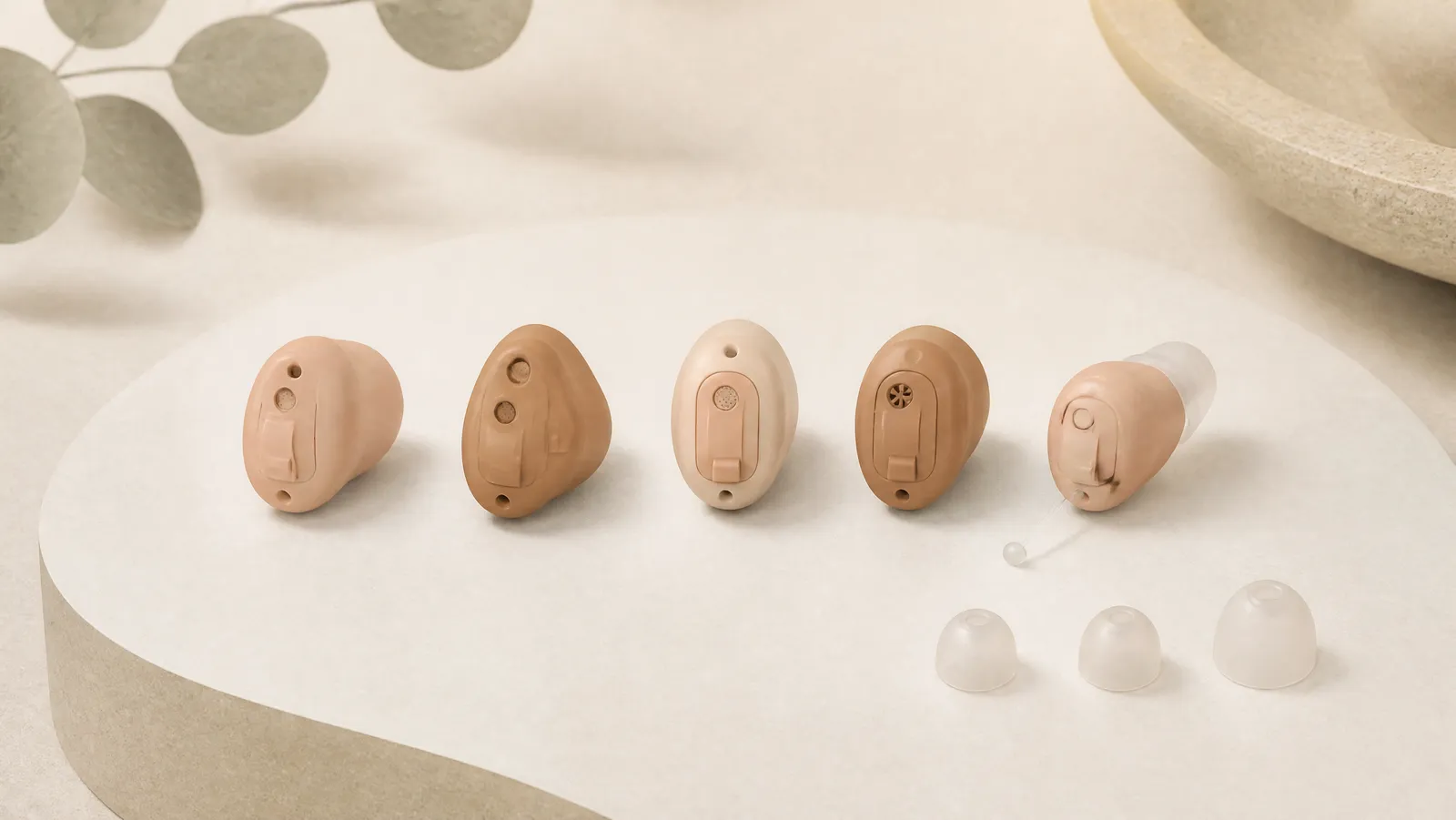
The Most Discreet OTC Hearing Aids of 2026
Invisible OTC hearing aids do not really exist, but some are genuinely discreet. Five in-canal picks for 2026, and what going smaller actually costs you.
OTC Hearing Aids and Severe Hearing Loss: Where the Limit Is
OTC hearing aids for severe hearing loss are outside the FDA category, which covers perceived mild to moderate loss. Here is where the line sits, and why.